
Ever read something online and thought, “This feels off… it’s too perfect. It’s not just unnatural, it’s robotic!”? Congratulations—you’ve just encountered the infamous “It’s not just X, it’s Y” AI sentence structure. Yes, artificial intelligence is often guilty of writing with a formula more predictable than an action movie plot twist.
In fact, the above paragraph was written with AI, ChatGPT to be specific. So was this one. Just kidding, it wasn’t- but it goes to show that as a writing tool, it has come a long way and can be a legitimate help. However, it tends to be quite repetitive, so I’m going to highlight what to look for so you can spot (and avoid) sounding just like everybody else on the internet right now.
spotting the dead giveaways: “it’s not just X, it’s Y”
AI-generated content tends to reveal itself through signature phrases and overly predictable language patterns. One of the biggest culprits? You guessed it: the infamous “it’s not just X, it’s Y” sentence structure. If your post reads like it was written by an AI companion, you’re probably not fooling anyone (except maybe another bot).
Here are a few telltale signs you’re dealing with content cooked up by a computer:
- Overly Dramatic Contrasts: “It’s not just efficient, it’s revolutionary.” (Yawn.)
- Overuse of em dashes (these things: “–”): “Congratulations—you’ve just encountered the infamous…”
- Repeated Patterns: Notice how everything is always “not just something, but something else entirely”? Interesting…
AI writing tools rely on pattern recognition and replication. Because marketing language often uses exaggerated contrasts, the AI thinks that by upping the stakes, it sounds more persuasive. But humans don’t necessarily buy into hyperbole that easily. We prefer authenticity, nuance, or at least humour.
breaking free of AI’s grip: what to do instead
The good news is you don’t have to banish AI writing tools altogether. They’re helpful, game-changing even, when used correctly. The trick is knowing how to humanise them and sound more natural.
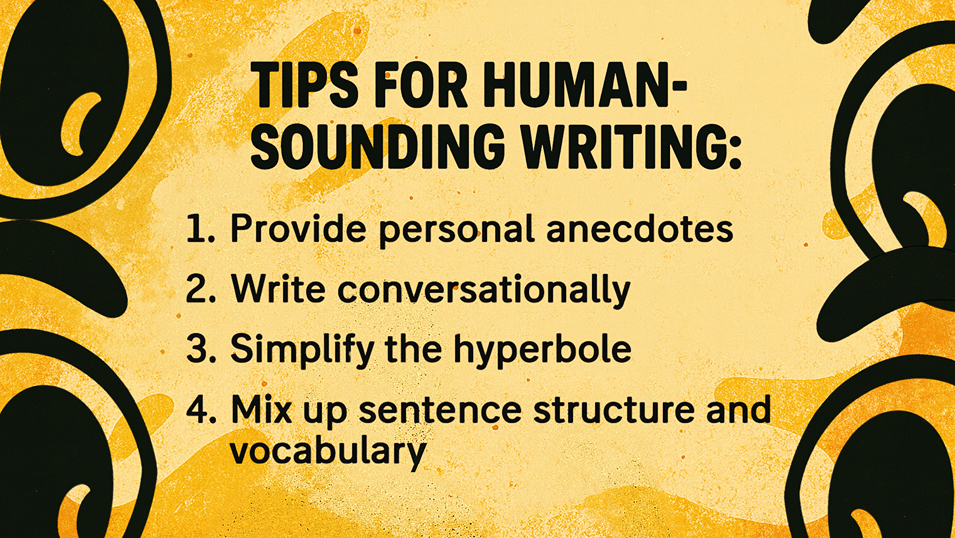
Tips for More Human Sounding Writing:
1. Provide personal anecdotes
Draw on your own experiences and relay them in your writing. People connect with personal stories and are much more likely to relate to another human being.
- AI version: “This software isn’t just convenient; it’s revolutionary.”
- Human version: “Honestly, this software has been pretty handy in my day to day. Definitely beats spreadsheets (sorry, Excel lovers).”
2. Write conversationally (and Use Humor)
Humour is profoundly human and immediately sets your writing apart from AI-generated jargon.
- AI version: “Our tool is blazing fast.”
- Human version: “Our tool speeds things up enough that you might actually leave work on time.”
3. Simplify the hyperbole
Marketing doesn’t always have to scream “groundbreaking!” Sometimes it just has to say, “this makes your day a bit easier.”
- AI version: “This isn’t just powerful—it’s game-changing.”
- Human version: “It’s probably not going to change the world, but hey, your marketing campaigns will get a nice bump.”
4. Mix up sentence structure and vocabulary
AI loves repeated structures because they’re predictable. People, however, typically enjoy varied phrasing.
- Swap generic buzzwords (“transformative,” “disruptive,” “unparalleled”) for conversational synonyms or real-world examples.
how to use AI properly (without sounding like a robot)
Think of AI as your intern: highly motivated, super fast, and a bit naive. Always review and tweak what AI writes, and take its answers with a pinch of salt.
Here’s a quick checklist to ensure you do:
- Start with AI: Let the AI give you the structure and additional ideas for your work. It is faster than you at coming up with options.
- Inject your personality: Rewrite awkward phrases with personal anecdotes, relatable jokes, or analogies.
- Tone down the hype: Swap out extreme adjectives for measured, believable language that a person would actually use.
- Try reading it out loud: If it sounds unnatural spoken, it’s unnatural written.
final thoughts
Using AI in writing can feel like cheating, but as long as your use is not obvious (or worse, obviously lazy), you don’t have anything to worry about. Ditch the tired clichés, let your personality come out, and stop sounding like a robotic motivational speaker. Readers will appreciate it, and are more likely to connect with it.
In other words: Your writing shouldn’t just be efficient, it should sound human. (See what I did there?)
If you need help with content development and copywriting, or just want to sound more human in your marketing copy. Send us an email so we can help you out. Or if you’re worried your current stuff sounds a bit robotic, get a free website review and we’ll tell you where you can improve.