
We Tested AI Website Builders So You Don’t Have To. The Results Were… Interesting.
It had to happen eventually. AI website builders have crossed from novelty into the mainstream, and in 2026, they’re genuinely impressive. Tools like Wix AI, Framer, Squarespace AI, and a wave of newer entrants can now generate a multi-page website, complete with copy, layout, colour palette, and basic on-page SEO, from a single text prompt. In under ten minutes.
For South African business owners watching every rand, this sounds like a no-brainer. According to Cybernews’ 2026 ranking of AI website builders, the technology has gone from producing clunky landing pages to building full business websites that are mobile-friendly, visually polished, and ready to publish. The global AI website builder market is expanding at roughly 29% per year, driven by solopreneurs, service businesses, and early-stage startups that need an online presence fast.
So here’s the obvious question: if AI can do all of this, why would you pay a web designer?
It’s a fair question. And the answer is more nuanced than most agencies would like to admit.
What AI Website Builders Actually Do Well
Credit where it’s due. If you need a basic online presence quickly and affordably, AI builders have become a legitimate option. They handle template selection, placeholder copy, responsive layouts, and even image sourcing in a single pass. For a freelancer who just needs a portfolio page, or a side-hustle that needs to exist online while the founder figures out the business model, this is a great starting point.
The speed is real. The cost savings are real. And for businesses that previously had no website at all, getting something live is better than staying invisible. In South Africa, where nearly 97% of consumers search online before making a purchase and where many small businesses still don’t have a functional website, that kind of accessibility matters to them.
Where Things Start to Fall Apart
The problem isn’t what AI builders can produce. It’s more about how they struggle to differentiate.
When every business in your industry has access to the same AI tools drawing from the same design patterns, the output starts to converge. As design agency Tilipman Digital pointed out in their 2026 trend analysis, “Every brand wants to stand out, yet most of them end up with similar visuals and stale tones of voice.” The AI doesn’t know your customers. It doesn’t understand that your Cape Town physiotherapy practice needs to convey clinical trust differently than a Joburg streetwear brand. It just knows what a “health and wellness website” generally looks like based on thousands of other health and wellness websites.
We see this regularly in our own work. A new client comes to us after building their site with an AI tool or a template platform. The site looks fine on the surface. But when we dig in, the issues become clear:
- The site doesn’t convert. It exists, but it doesn’t guide visitors toward a specific action. There’s no strategic thinking behind the page structure, no clear calls to action, and no understanding of what the visitor actually needs to see before they’ll pick up the phone or fill out a form. AI can generate a “Contact Us” button, but it doesn’t know where to place it in the context of your customer’s decision-making journey.
- SEO is surface-level at best. AI builders apply basic meta tags and page titles, but competitive search ranking requires deeper work: site architecture, internal linking strategy, content that targets the specific phrases your customers are searching for, and ongoing optimisation as search behaviour shifts. With Google’s AI Overviews now dominating search results pages (something we wrote about in our blog on GEO), surface-level SEO is less effective than ever.
- Performance and speed are inconsistent. Template-based sites often carry bloated code, unused scripts, and unoptimised images that slow things down. Research consistently shows that even small improvements in load speed increase conversion rates, so performance stops being a technical concern and becomes a revenue one.
- Brand identity gets lost. A website should feel like an extension of your business. Your tone, your story, the way you want customers to feel when they land on your page — none of this translates through a text prompt. We’ve worked with clients across e-commerce, healthcare, beauty, tech, and nonprofits, and the one consistent truth is that the businesses with strong online identities are the ones whose websites were built around their brand, not assembled from a template that could belong to anyone.
The South African Context
These limitations hit harder in the local market. South African entrepreneurs face a specific set of digital challenges that AI tools aren’t equipped to address.
According to a 2025 report by SA Business Integrator, 80% of small businesses in South Africa fail within the first five years. The margin for error is shrinking. Capital is moving slowly, customers are quicker to walk away, and the pressure to get your digital presence right the first time is higher than it’s ever been. A generic AI-generated website might check the “I have a website” box, but it won’t help you stand out in a market where your competitors are one Google search away.
So When Should You Use an AI Builder?
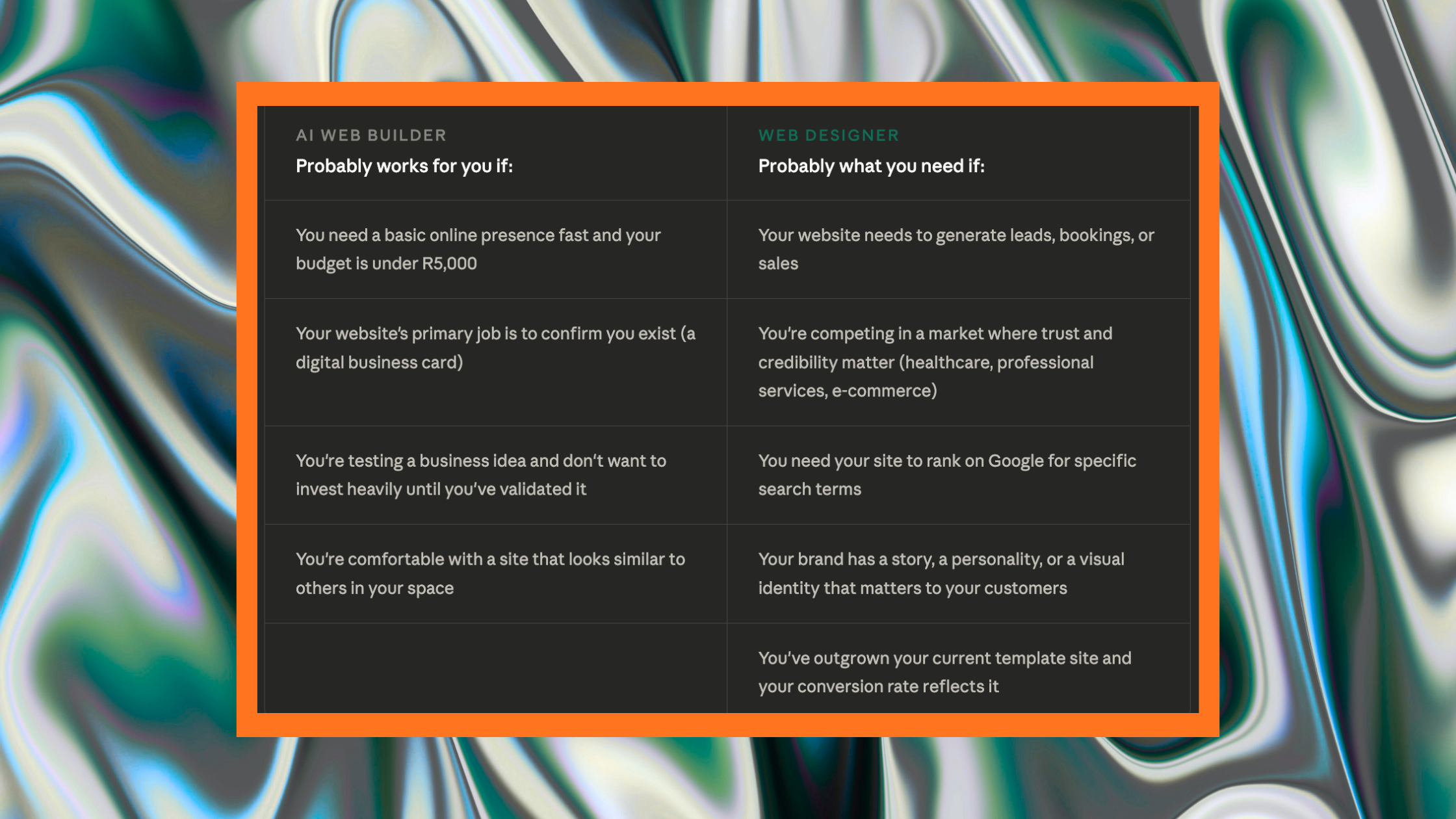
AI website builders aren’t a scam. They serve a purpose, and for some businesses at certain stages, they’re the right call. Here’s when you should use an AI Web Builder instead of hiring a professional web designer:
An AI Web builder probably works for you if:
- You need a basic online presence fast and your budget is under R5,000
- Your website’s primary job is to confirm you exist (a digital business card)
- You’re testing a business idea and don’t want to invest heavily until you’ve validated it
- You’re comfortable with a site that looks similar to others in your space
You probably need a web designer if:
- Your website needs to generate leads, bookings, or sales
- You’re competing in a market where trust and credibility matter a lot (healthcare, professional services, e-commerce)
- You need your site to rank on Google for specific search terms
- Your brand has a story, a personality, or a visual identity that matters to your customers
- You’ve outgrown your current template site and your conversion rate reflects it
Final Thoughts
The rise of AI website builders is the biggest shift in our industry right now, and pretending otherwise would be dishonest. They’ve made it easier and cheaper than ever to get online. That’s a good thing, especially for South African entrepreneurs who are working with tight budgets and limited time.
But easier doesn’t always mean better. And cheaper upfront doesn’t always mean cheaper in the long run, something we see play out regularly when clients come to us after their template site hasn’t delivered results.
If you’re unsure whether your current website is working for your business or just taking up space on the internet, we’re happy to take a look. Get in touch with us and we can talk through where you are, what you need, and whether it makes sense to rebuild, refine, or start from scratch.