
The best South African business story of the last decade might also be the least talked-about outside of tech circles. In 2016, only around 6% of sellers in the country accepted card payments, even though more than 27 million South Africans were walking around with a bank card in their pocket. That gap was the whole opportunity.
The Big Five banks had capital, distribution, a merchant services team at each one, and decades of retail relationships. They still lost the small business market. They lost it to four friends in Cape Town who started with a small blue card reader and a website.
Here’s how Yoco went from that first transaction to a business valued at around R12.5 billion, processing more than R34 billion in card sales a year for over 200,000 South African merchants, and what we think it means now that the founding CEO has stepped away.
The problem no bank wanted to solve
Yoco was founded in 2013 by Katlego Maphai, Carl Wazen, Bradley Wattrus and Lungisa Matshoba. The idea came from two places: watching what Square had done for small merchants in the United States, and Maphai’s own experience of paying with a card reader while travelling in Silicon Valley. He came home, looked at the same problem locally, and it was worse.
If you ran a spaza, a Saturday food stall or a hair salon at the time, the standard bank card machine came with a fixed monthly rental, a long contract and per-transaction fees that made no sense at low volumes. So most small businesses just stayed cash-only. That’s a lot of missed sales, and a lot of untraceable revenue.
The pebble that started it
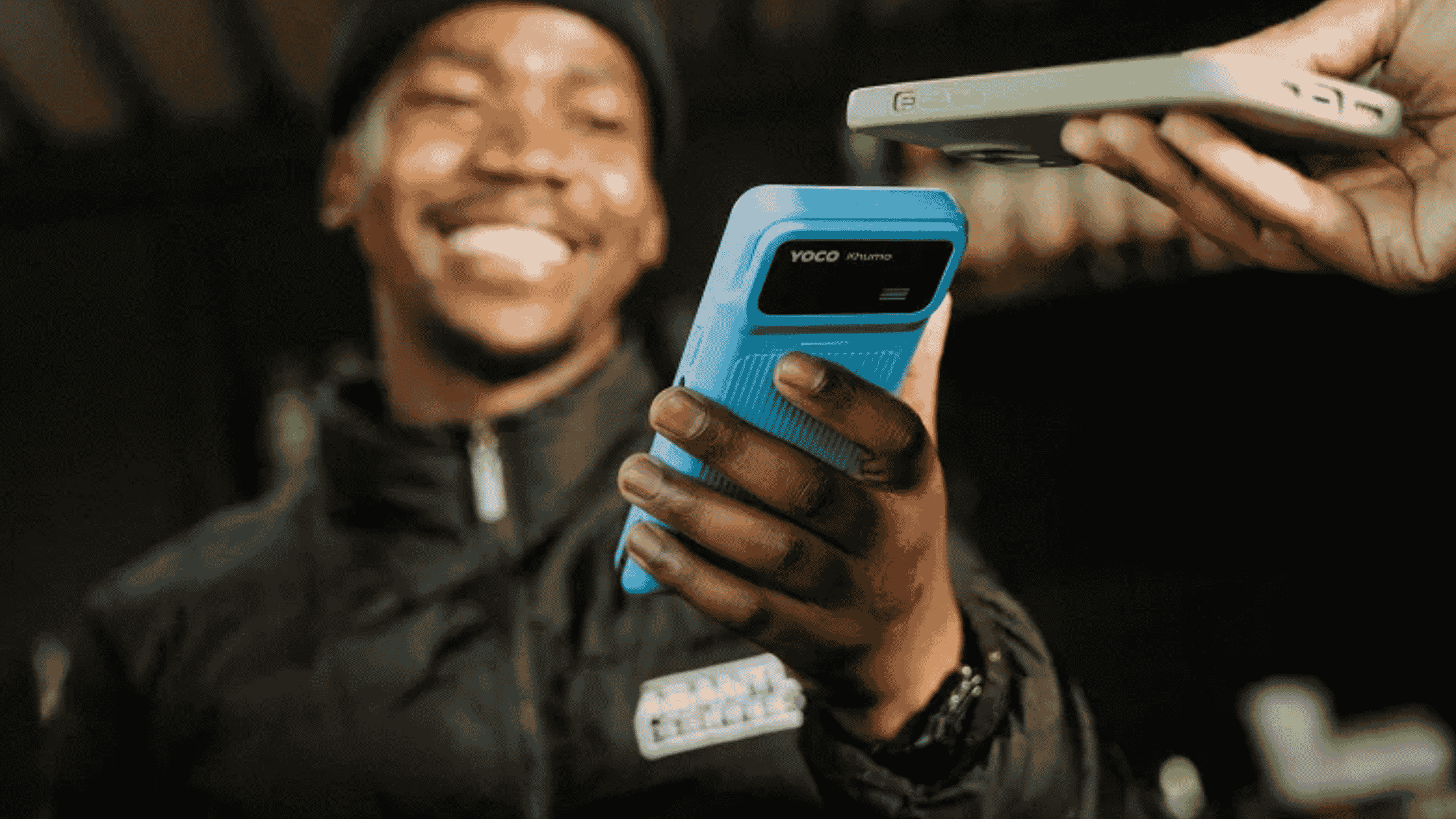
Yoco processed its first transaction in October 2014. The first product was a small blue Bluetooth card reader that plugged into a smartphone. No monthly fee. Pay-as-you-transact pricing. Sign-up online instead of at a bank branch. By the end of 2016, Yoco had 5,000 active merchants. By September 2018 the number was 27,000, and the company was adding around 1,500 more every month while processing R3.5 billion a year in card sales.
That same year Yoco closed a $16 million Series B round led by Partech, and launched Yoco Capital, its merchant lending arm. The pitch to merchants was simple: get short-term working capital, pay it back through a slice of your daily card sales, no branch visits.
The lending numbers made the point better than any deck could. In the first year of operation, Yoco Capital disbursed R55 million in small business loans with a default rate of just 2%. That was the number the traditional banks had told themselves for years was impossible: profitable, low-risk lending to informal and semi-formal merchants who did not fit the standard credit scorecard.
The pandemic and a R1.23 billion funding round
2020 broke a lot of small businesses. It also made it very clear that cash-only was a liability. Yoco’s online payments volume grew roughly ten times over twelve months as merchants scrambled to sell through WhatsApp, Instagram and simple checkout pages.
That trajectory attracted serious international money. In July 2021, Yoco closed a Series C worth $83 million (around R1.23 billion), led by US-based Dragoneer Investment Group, whose previous fintech bets included Nubank, Square and Klarna. It was the largest single funding round ever raised by a South African payments company at that point.
The company used the money to keep building product. Yoco expanded from its blue Bluetooth reader into a full range of standalone terminals: Yoco Go, Yoco Neo and later Khumo. The Khumo is worth mentioning specifically because it is designed, assembled and packaged in South Africa. That matters when a company that started out depending on imported hardware ends up building its own kit locally.
The retail push started in October 2021, when Yoco terminals appeared on the shelves at Builders Warehouse and Makro. For the first time, a South African business owner could buy a card machine off the shelf the same way you buy a kettle.
200 000 merchants and a Cape Town software agency
Between 2022 and 2025, the base kept growing. Yoco acquired Nona Digital, a Cape Town-based software agency, in March 2022 to accelerate its own product engineering. By late 2025 the company was serving over 200,000 South African businesses, processing more than R34 billion a year in card sales, employing close to 400 people and had raised over R1.7 billion in total funding.
That’s the point at which the story got interesting again.
The banks did eventually notice, and by 2025 the payments landscape looked completely different. Nedbank acquired iKhokha, Yoco’s main direct competitor, for R1.65 billion. Capitec launched its own card machine offering aimed squarely at Yoco’s market. Lesaka Technologies acquired Adumo and Bank Zero. Every one of those moves was a bet that the small business payment space was worth owning, and that the era of Yoco having the field to itself was over.

The founder steps down
In September 2025, Katlego Maphai announced on LinkedIn that he was stepping down as CEO after a decade in the job. His reasoning was direct: “the skills and energy needed to start and build a company are not always the same as those required to scale it to the next level”. Co-founders Lungisa Matshoba and Bradley Wattrus took over as co-CEOs, Carl Wazen kept commercial operations, and Maphai stayed on in a founder role focused on longer-term strategy.
Nine months later, in June 2026, Yoco appointed Carsten Höltkemeyer as its first external CEO. He spent a decade running Barclaycard Germany and most recently led Berlin-based embedded finance group Solaris. It was the first time in Yoco’s 11-year history that anyone other than a founder ran the company.
That’s a significant admission. It says the founding team believes the next phase of Yoco needs skills they don’t have. It also says the competition from Nedbank, Capitec and the rest is being taken very seriously.
What this actually means for South African business owners
If you are running a business in South Africa right now, the practical takeaway is that you have more real options than at any point in the last decade, and the pricing pressure is only going to keep building. Yoco is no longer the only credible route for a merchant who wants an off-the-shelf card machine with no monthly rental, and that is a good thing for buyers.
The bigger story is what Yoco proved over the last twelve years. South African small businesses were never the low-value, high-risk segment the banks had assumed they were. They just needed a product built for how they actually work: no long contracts, no monthly rental, straightforward pricing, and onboarding that took days instead of weeks. Once someone built that, hundreds of thousands of merchants signed up.
The lesson translates neatly if you are building your own business right now, whether it is a service company, an online store or a physical shop. Fitting the product to the buyer, not the buyer to the product, is what turned 5,000 users into 200,000 in ten years. Everything else is execution.
If your business has grown to the point where the way you get paid is more sorted than the way you get found online, that is exactly the kind of problem we work on at JCKFRUT. Come and have a chat and we can help you figure out the right next move for where your business is right now.