
Earlier this month Shoprite started testing something called FillRite in three Gauteng stores, most of them under its USave discount format. You bring your own container, press a button, and fill it with cooking oil, maize meal, flour, sugar or rice, and the dispenser prints a label showing the weight and the price. Dry goods start at R5. Oils and home care products start at R10.
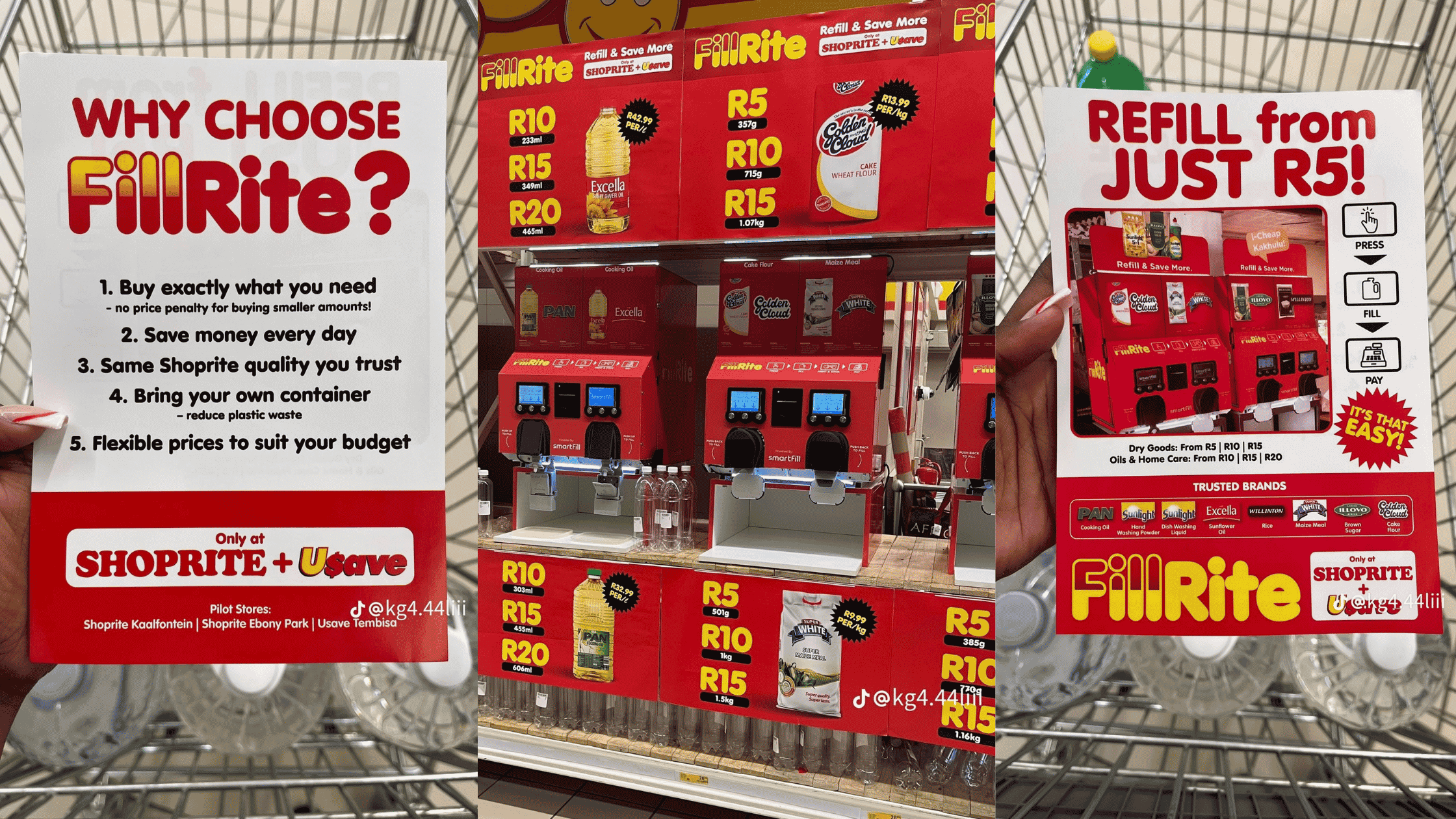
Within a day of the story going viral on social media, the comments had already decided where the idea came from. South Africans accused Shoprite of copying Skubu, a refill grocery store in Diepsloot founded by Eben de Jongh, which has been selling maize meal by the kilogram since July 2025 with backing from the CSIR and the Department of Science, Technology and Innovation. Some called for legal action. Shoprite told BONA that the refill station is being piloted as part of an action learning project inside its leadership development programme, and that there are currently no plans to expand it.
The grievance is real and we would rather not wave it away. Skubu built the thing, priced 500g of brown sugar at R10 when Shoprite was charging R20 for the same weight, proved the model holds up in a low-income market, and then watched the largest food retailer on the continent run its own version of it in Gauteng. Anyone who has built something and then seen it absorbed by a bigger balance sheet will recognise the feeling precisely.
They didn’t invent it
But claiming theft gets the story slightly wrong, and the way it gets it wrong is the part worth reading twice. FillRite is built on the Smartfill platform, an existing dispenser technology that has been installed in spaza shops in Tembisa since the middle of 2025, stocking rice, maize meal, oats, cooking oil and washing powder from brands including Sunlight and Mielie King.
Refill retail did not begin with Shoprite, and it did not begin with Skubu either. It began with the spaza shop, which has been selling loose single units for as long as it has existed and never filed a patent on any of it.
What the dispensers formalised was not a technology. It was a simple arrangement that spaza shops have understood for decades. A 2kg bag of rice asks you to pay today for food you will finish in three weeks, which hands the shop its cash up front and leaves you carrying the risk that the money turns out to be needed somewhere else before the bag runs out. If you can absorb that, you get a lower price per kilogram as a reward. If you cannot, you pay more per kilogram than the person who could, week after week. That is what a bulk discount actually is, and refill retail does not fix it. It just stops charging people extra for being short.
Which brings us to why a founder running a business with nothing to do with maize meal should care. The sector we call informal has worked out four things that formal businesses pay people like us to advise them on, and it worked them out without a strategy document:
1. Sell smaller, sell quicker
The first is the one the refill story is about. NIQ South Africa’s State of the Retail Nation report put traditional trade at R43.1 billion in sales for the first quarter of 2026, while modern retail’s unit sales grew 1.7%. NIQ counts roughly 150,000 traditional trade outlets against about 10,000 modern trade ones. Research on spaza shops in township communities has shopkeepers putting it in plainer terms than any consultant would: selling in smaller units meant customers came in every day, and coming in every day was how the relationship got built.
Simply put: if you sell one thing at R25,000, you’d meet your customer once a year at best. The useful question is not how to reach more people. It is what you could sell at R1,500 a month that would put you in front of the same person twelve times instead.

2. Credit works a little differently
The second thing is credit. Spaza shops extend it constantly, written on a page in an exercise book, with no contract and no credit check, to customers the shop is confident will pay because the shop knows where they live. That same research describes book credit as an informal safety net resting on trust and familiarity. Formal businesses run this in reverse. They ask strangers for fifty percent up front and then hold meetings about the drop-off rate.
You cannot manufacture knowing where someone lives, but you can work out what carries similar weight at a distance, which is usually visible proof of work, a name the customer already recognises, and being reachable on the channel they use anyway. (We have written before about why that channel is almost always WhatsApp.)
3. A grocery stokvel has tighter terms than your business
The third thing might sting a little. A 2026 University of Cape Town study published in the Journal of Nutrition Education and Behavior examined twenty grocery stokvels in Dunoon and Khayelitsha, groups of ten to thirty members contributing between R200 and R1,500 a month. All twenty operated under a written constitution. Eighty-five percent enforced penalties for breaking the rules. Nationally, Ipsos puts the sector at around R50 billion across more than 800,000 groups and roughly 11 million members, most of it still running on cash.
Now think about your last three client agreements. If you have ever let an invoice drift past ninety days because raising it felt rude, agreed to a fourth round of revisions that was never in scope, dropped a deposit requirement because the client seemed decent, or taken a verbal yes as a signature, then you are being outperformed on governance by a savings group with a R200 monthly contribution and a hand-written constitution.
Informal doesn’t mean disorganised.
4. Own a route instead of buying attention
The fourth thing is distribution, and the taxi industry is the clearest example of it in the economy. Minibus taxis account for roughly 70% of daily public transport commutes, far ahead of buses and trains, according to a 2026 paper in Frontiers in Sociology on social capital in the industry. They carry that load without the subsidy that bus and rail operators receive, while charging more than both, because they reach places buses and trains do not. There is no advertising anywhere in this. The industry does not compete for attention at all. It controls routes, ranks and territory, and enforces that control through associations.
The founder version of owning a route is narrower than it sounds, and less romantic. It means being the obvious choice in one specific place, whether that place is a suburb, an industry, a single referral relationship or one platform, rather than being mildly visible across six of them.
We should also say where this lesson stops, because route protection in that industry has produced real violence over the years and there is nothing in that worth borrowing. The mechanism is instructive. The enforcement is not.
In conclusion…
There is an uncomfortable line running through all four. The informal sector operates with that much discipline partly because it has no alternative: no courts worth the filing fee, no collections department, no subsidy, no overdraft to absorb a bad month. Formal businesses have most of that recourse sitting available and almost never use it, and having it is exactly what makes the looseness affordable. Small units, tight terms, proximity and an owned route are what you build when nothing else is coming to save you.
So the question is not which of the four to copy. It is whether your business can learn from informal businesses in this country that have had to find creative solutions for their problems. If you would like to figure out some for your own business, we are happy to help.
What we keep wondering is how many other ideas currently being piloted inside leadership development programmes have been running on a shop counter in Tembisa for two years already, waiting for somebody to notice.