
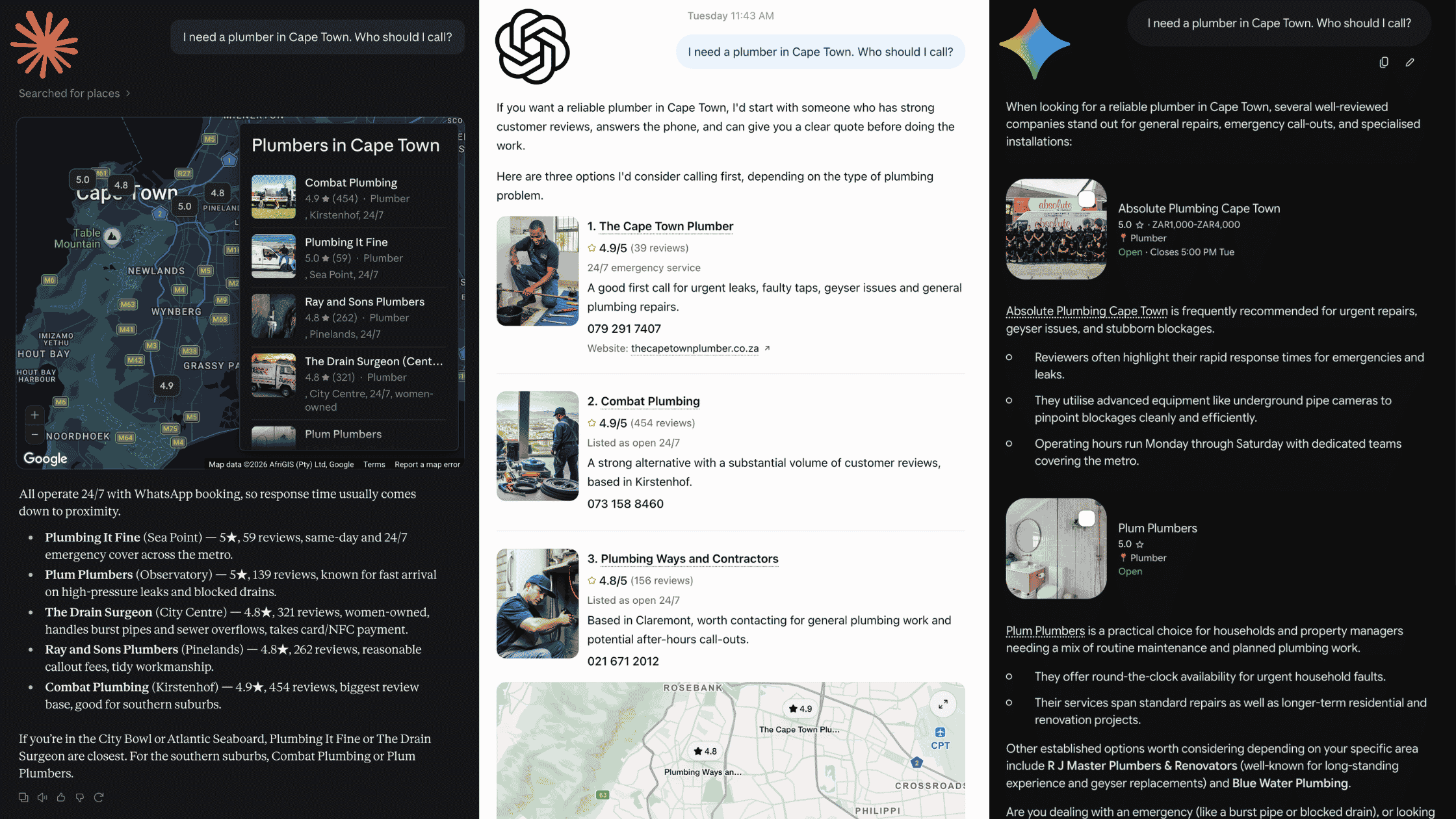
We typed the same sentence into ChatGPT, Claude and Gemini: “I need a plumber in Cape Town. Who should I call?”. Between them they recommended ten different businesses, and not one of those businesses appeared on all three lists.
We ran the test because we noticed that the way people find a plumber, an electrician or a web designer is shifting faster than most business owners have noticed. BrightLocal’s 2026 Local Consumer Review Survey found that 45% of consumers now use AI tools for local business recommendations, up from 6% a year earlier. That survey covers American adults, so we will not pretend it describes South Africa precisely, but the behaviour is clearly here too. A Google and Ipsos study of 1,000 South African adults found that 70% have used an AI chatbot, up 25 points since 2023.
So we wanted to know something practical. When an AI tool recommends a local business, what do the businesses it picks have in common? And how can a business owner use this info to their advantage?
No unanimous agreement
Here is what each tool named.
- ChatGPT recommended the following businesses:
- The Cape Town Plumber
- Combat Plumbing
- Plumbing Ways and Contractors
- Claude recommended
- Plumbing It Fine
- Plum Plumbers
- The Drain Surgeon
- Ray and Sons Plumbers
- Combat Plumbing
- Gemini
- Absolute Plumbing Cape Town
- Plum Plumbers
- R J Master Plumbers & Renovators
- Blue Water Plumbing
Only two businesses showed up twice. Combat Plumbing appeared on Claude’s list and ChatGPT’s. Plum Plumbers appeared on Claude and Gemini’s. Everyone else was named once.
If you have spent any time thinking about Google rankings, the instinct is to ask who came first. That instinct does not seem to apply here. Asking three AI tools for a plumber is closer to asking three neighbours over the fence: each one has a shortlist built from what they happen to have seen and heard, the lists overlap a little, and nobody has a definitive ranking because there isn’t one. The useful question is not how to rank first, it is how to end up on the shortlist more often.
That is what the rest of this post is about. We looked up every one of the ten businesses and checked the same things for each: their rating and review count, their Google listing, whether they have a website and what it says, and where else they are listed online. Six patterns came through. Here they are:
1. 4.8 is the golden number ⭐
Eight of the ten businesses had a rating shown in the AI answers. Every single one sat at 4.8 stars or higher. Combat Plumbing, Ray and Sons, The Drain Surgeon and Plumbing Ways were at 4.8 or 4.9. Plum Plumbers, Plumbing It Fine and Absolute Plumbing were at 5.0.
Ten businesses is a small sample to be clear, not enough to call 4.8 a rule. But when three different tools, built by three different companies, all recommend nothing under 4.8 on it, a business sitting at 4.2 should take the hint.
2. Review volume is not a dealbreaker
This is the part that should encourage smaller businesses. The Cape Town Plumber was recommended by ChatGPT with 39 reviews. Plumbing It Fine was recommended by ChatGPT with 59. Combat Plumbing had 454.
So the tools are not simply picking whoever has the most reviews. A high rating seems to get you into consideration, and volume helps you win when there are several good options. Claude made this explicit when it described Combat Plumbing as having the “biggest review base”, which is how it justified including a business it otherwise described in fairly general terms.
3. Websites still matter. A lot.
Every business named had a website of its own. Not one was recommended on the strength of a Google listing alone.
Directory listings were more mixed. Ray and Sons Plumbers turns up on at least seven local directories, including Uptasker, Procompare and the Pinelands Portal. The Cape Town Plumber, on the other hand, only appeared on Hotfrog in our search, and ChatGPT still named it. Directories are common among these businesses, but on this evidence they are not what decides the outcome. The website is the more consistent signal.
A website also allows the AI to directly link to it, providing a straightforward path to receiving a booking. The AI can only act as a refferal tool as far as you give it something to work with.
4. Cheating the system?
Plum Plumbers was one of only two businesses recommended by more than one tool. It also has a page on its site titled “Best 24 hour emergency plumbers near me in Cape Town”.
Plumbing Ways and Contractors has a “Plumber Cape Town Guide”. Absolute Plumbing publishes explainer articles like “What To Look For In A Professional Plumbing Company”.
These are not clever pages. They answer, in plain words, the exact question a customer is likely to ask. When an AI tool goes looking for the answer to that question, a page that already contains it is easy to find and easy to quote. Most small business websites have a home page, a services page and a contact form, and none of those three pages actually says “we are a 24 hour plumber covering these Cape Town suburbs” in a sentence the AI can immediately pick up.
5. Clearly state when you are available
Claude opened its answer with “All operate 24/7 with WhatsApp booking.” Claude labelled all three of its picks as 24/7 or emergency services. Gemini described Plum Plumbers as offering round-the-clock availability.
Our question did not mention an emergency. The tools assumed that someone asking for a plumber probably has a problem right now, and they leaned toward businesses that had clearly stated they could help immediately. The one notable exception proves the point: Gemini recommended Absolute Plumbing, which it listed as open Monday to Saturday and closing at 5pm, and Gemini was also the only tool that did not frame its answer around emergencies.
If your hours, your call-out availability and the way people can book you (phone, WhatsApp, online form) are not stated clearly on your Google listing and your website, the tool has nothing to work with.
6. Specific details get repeated back to the customer
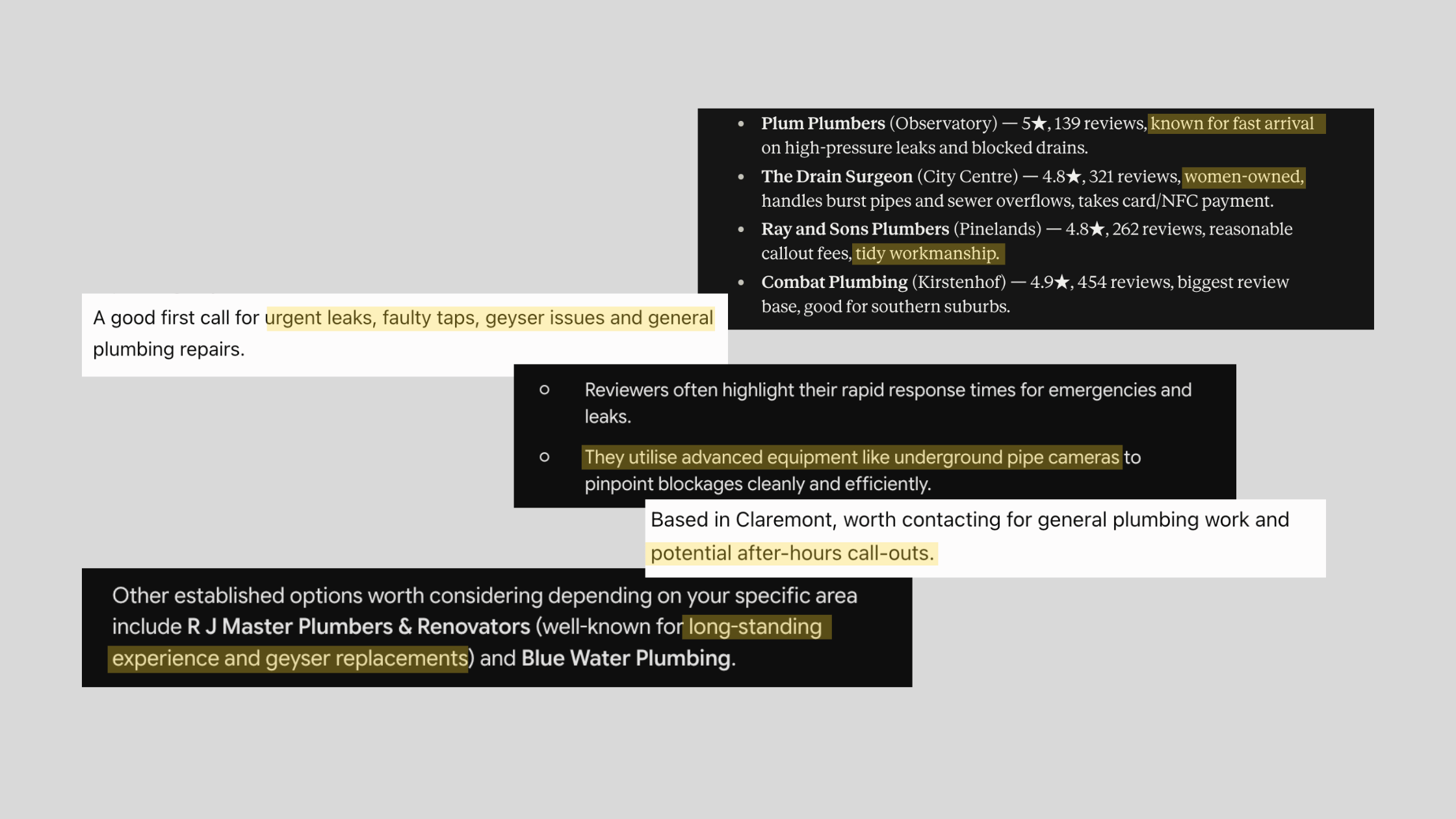
This is the pattern we found most useful. The tools did not just list names. They described each business, and the descriptions were built from specific facts.
Claude told us The Drain Surgeon is women-owned and has tap-to-pay. Gemini told us Absolute Plumbing charges roughly R1,000 to R4,000 and uses underground pipe cameras to find blockages. ChatGPT described Ray and Sons as having “reasonable callout fees” and “tidy workmanship”, language that reads like it came straight from customer reviews. Every tool attached a suburb to every business (Kirstenhof, Sea Point, Pinelands, Observatory, Claremont) and used location to suggest who to call first.
Some of those details come from Google Business Profile, which lets you list attributes like ownership, payment methods and price ranges. Some come from website copy. Some come from what customers write in reviews. Wherever they come from, the effect is the same. A business with vague information gets a name in a list. A business with specific information gets a sentence explaining why you should pick it, and that sentence is what the customer actually reads.
Getting named is where the work starts
There is one more finding worth knowing, and it changes how you should think about all of the above.
The same BrightLocal survey found that 88% of people who use AI for local recommendations fact-check what it tells them, and 42% always go and check reviews on a review platform afterwards. An AI recommendation is not the end of the decision. It is a referral, which the customer then uses to look you up.
That is why the patterns above fit together. The rating gets you on the list. The specific details on your listing and your website give the tool something to say about you. And when the customer leaves the chat to check you out, the same rating and the same clear information are what they find.
What this test can and cannot tell you
We ran one search, for one trade, in one city, on one day.. Ask the same question tomorrow and you may well get different names, which is part of the point.
What the test does show is consistent enough to act on. Every business recommended had a strong rating, its own website and clear, specific information about what it does, where it works and when it is available. None of that requires a marketing budget. Most of it is a free afternoon spent on your Google Business Profile and a few hours rewriting your website so that it answers the questions your customers actually ask.
If you would like a second pair of eyes on whether your website does that, we are happy to take a look. And if you run this test for your own industry and get a completely different result, we would like to hear about it, because ten plumbers in Cape Town is a starting point, not the final word.